
Blog Details
- Member
- April 2, 2026
Srijan Sanchar Framework of Frameworks
A Universal Grammar for Intentional Action
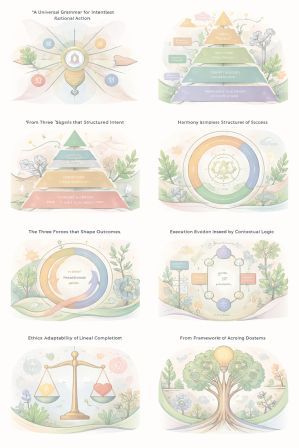
The Harmonic Evolution Meta-Framework (HEM) proposes a universal grammar for purposeful action across domains. Instead of building separate frameworks for business, science, design, governance, or personal development, HEM provides a common structure that maps how signals become intentions, intentions become systems, and systems evolve through feedback. The framework integrates perception, planning, execution, and reflection into a single continuum, enabling coherent movement from raw input to meaningful transformation.
From Signals to Structured Intent
Every purposeful activity begins with a signal—an observation, need, opportunity, or disturbance. HEM treats this signal as the starting point of intentional flow. The signal is interpreted, framed into strategy, organized into architecture, executed into reality, and evaluated for impact. This creates a structured pathway where ambiguity gradually transforms into clarity. The framework therefore serves as a bridge between sensing and doing, ensuring that action is grounded in interpretation rather than reaction.
Layers of Complexity from Material to Meaning
HEM recognizes that systems operate across multiple levels of complexity. At the base lies the material layer—data, resources, and observable inputs. Above it are standards that define rules and constraints. Methodologies then organize these standards into repeatable processes. Systemic considerations incorporate broader ecological and social contexts. At the highest level lies transcendental meaning—purpose, ethics, and long-term direction. These layers allow decisions to be evaluated not only for correctness but also for relevance and sustainability.
The Three Forces that Shape Outcomes
The framework introduces three governing forces that guide any evolving system. Integrity ensures internal coherence and alignment between inputs, methods, and purpose. Impact measures whether actions produce meaningful change in the intended direction. Vitality safeguards long-term sustainability and systemic health. Together, these forces create a dynamic balance. Systems dominated by impact alone may become efficient but destructive, while those focused only on integrity may become rigid. Vitality ensures adaptability without loss of direction.
Harmony as the Measure of Success
Traditional approaches often define success through a single metric such as growth, efficiency, or accuracy. HEM instead defines success as harmonic balance between integrity, impact, and vitality. A system that performs well but undermines its own foundation is considered unstable. Conversely, a system that preserves coherence and sustainability while generating meaningful transformation achieves harmonic resonance. This redefines success as equilibrium rather than maximization.
Execution Guided by Contextual Logic
HEM operates not as a fixed checklist but as an adaptive guide. Depending on the domain, it generates contextual checks that ensure alignment between intent and execution. In organizational settings, this may appear as validation between market data and product direction. In research, it may appear as alignment between hypothesis and methodology. In personal decision-making, it may appear as consistency between values and actions. These contextual logic gates emerge naturally from the structure of the framework.
Recursive Evolution Instead of Linear Completion
Rather than ending with execution, HEM emphasizes recursive evolution. Every outcome feeds back into perception, generating new signals. These signals refine intent, restructure systems, and guide further action. This transforms static workflows into evolving cycles. The framework therefore supports continuous learning, adaptation, and refinement without requiring a complete redesign at each stage.
Ethics as an Operational Component
In many frameworks, ethical considerations are treated as external constraints or afterthoughts. HEM integrates them directly into the decision process. Actions are evaluated not only for effectiveness but also for systemic consequences. This ensures that short-term gains do not undermine long-term viability. Ethics thus become operational rather than symbolic, influencing how strategies are chosen and how execution proceeds.
Context Adaptability Across Domains
One of the strengths of HEM is its domain independence. The same structure can be applied to designing a product, conducting research, governing institutions, or guiding personal growth. Because it focuses on relationships between signals, intent, structure, and outcomes, it adapts naturally to different contexts. This flexibility allows the framework to serve as a common language across disciplines.
From Framework to Living System
HEM ultimately functions as a living system rather than a static model. It receives inputs, organizes them into purposeful structure, executes transformation, evaluates outcomes, and evolves. By combining intentional flow, layered complexity, and triadic balance, it creates a self-regulating mechanism for navigating complexity. The result is a meta-framework that supports thoughtful action, adaptive learning, and sustainable evolution across diverse domains.